
Grant and I share an enthusiasm for the work of Oliver Jeffers. While I don’t think we have all his children’s books, we have a pretty substantial stack (including at least one missing one which is illustrated by him, The Day the Crayons Quit. Fittingly, the book seems to have quit our house. And another one he wrote and illustrated, How to Catch a Star – that one is in Grant’s room somewhere but I’m not finding it).

From top to bottom, we have Once Upon an Alphabet: short stories for all the letters, Here We Are: notes for living on planet earth, Where to Hide a Star, A Child of Books (created with Sam Winston), Meanwhile, Back on Earth: finding our place through time and space, There’s a Ghost in this House, I’m Very Busy: a (nearly forgotten) birthday book, Lost and Found, The Crayons Go Back to School (created with Drew Daywalt), The Fate of Fausto: a painted fable, The Way Back Home, Up and Down, What We’ll Build: plans for our together future, The Day the Crayons Made Friends (created with Drew Daywalt), and finally, The A Dictionary Story (created with Sam Winston) (a copy in French and English each).
The first one we got was Lost and Found. The most recent purchase was The Fate of Fausto, which I bought at the Brooklyn museum when visiting it by happenstance with Henry. Both I’m Very Busy and There’s a Ghost in this House I purchased while in Dublin for work. The French version of A Dictionary Story I bought in Quebec (also for work). When Grant and I visit the bookstore together, we beeline for the Js to see if there are any new Jeffers we can snap up. It’s a given.
I’m going to go on a lengthy and probably boring digression about what I like about each of these books. I think it’s worth my time because I really get a lot out of these books and the art in them, even though they are “children’s” books. And the reason for that is, I think, that Oliver Jeffers is so mindful when he’s creating, that there are depths to explore in each story. I recent went to visit his website for the first time ever, and was so utterly charmed and inspired. It’s worth a click. www.oliverjeffers.com. I showed it to Grant, who also enjoyed it, and I signed up for his newsletter (Oliver Jeffers’ not Grant’s. Though I would if he had one.)
Here we go. [hi, it’s future me, from 90% of the way through this post. Grant came home and we sat down together and went through each book so he could tell me his favorite part for each as well! So it’s twice as long now. Enjoy!]
The Missing Stories
I’ll first cover the books that are missing from the stack – How to Catch a Star and The Day the Crayons Quit.
How to Catch a Star
How to Catch a Star features the boy, who is also featured in Up and Down, Lost and Found, The Way Back Home, and in the background of a few others. Grant and I just call him “the boy” and I think that’s what he’s commonly known as. The boy wants to have a star of his own, as they’re so beautiful, and devises a plan to catch one. I was prepared for all the boy’s plans to fail, because how can one catch a star? There’s the fable of the sly fox who gifts another animal the moon by showing him the reflection in the river, and the other animal lets the fox pass by unharmed because he is so enchanted. And of course, imagine his rage when he discovers that it is just a reflection, not the real deal. That story is where my mind went, the first time we read this together. But that very much is not what happens! The gentle subversion of expectations as well as the effortless blending of imagination and reality (what is more real than what you perceive, after all) are what makes this book so very special to me.
The Day the Crayons Quit
In The Day the Crayons Quit, I like the story of how the crayons overcome their differences, and show how lovely it is to “color outside the lines” and “use the wrong colors” in order to make a much more fun and interesting world. And the illustration of both the white crayon and the peach crayon make me and Grant giggle every time.
The Boy
Up and Down
I suppose it makes sense to now talk about the other books the boy appears in. We’ll start with Up and Down.

Here you can see the boy and the penguin, best friends. What I love about this story, beside some pretty funny wordplay right at the end, is that their friendship demonstrates how two beings can enjoy doing everything together, but it’s also ok to try things separately. Even if, and maybe especially if, they don’t work out. It’s important not to judge each other, and simply to be present.
Grant: He’s trying to fly and finds a decision. And then he’s like “I made a big mistake!” And the boy is seeing he’s a cannonball and goes to save the penguin.
Lost and Found
Lost and Found. This one sometimes makes me weepy.

We must have an early version of this book, because it’s not in Oliver Jeffers’ signature handwriting. My copy says it was made in 2006, and it was first printed in the UK in 2005 (the first American printing was in 2006), so it is quite early. I think How to Catch a Star predates it chronologically. ANYWAY. I love this story so much. I fell in love with the art, but the story carried me away entirely. At its heart, it is about recognizing the gifts that each other bring, even when we don’t realize we needed them. Also, this picture below is one that Grant and I always always always pause on to just gaze at.
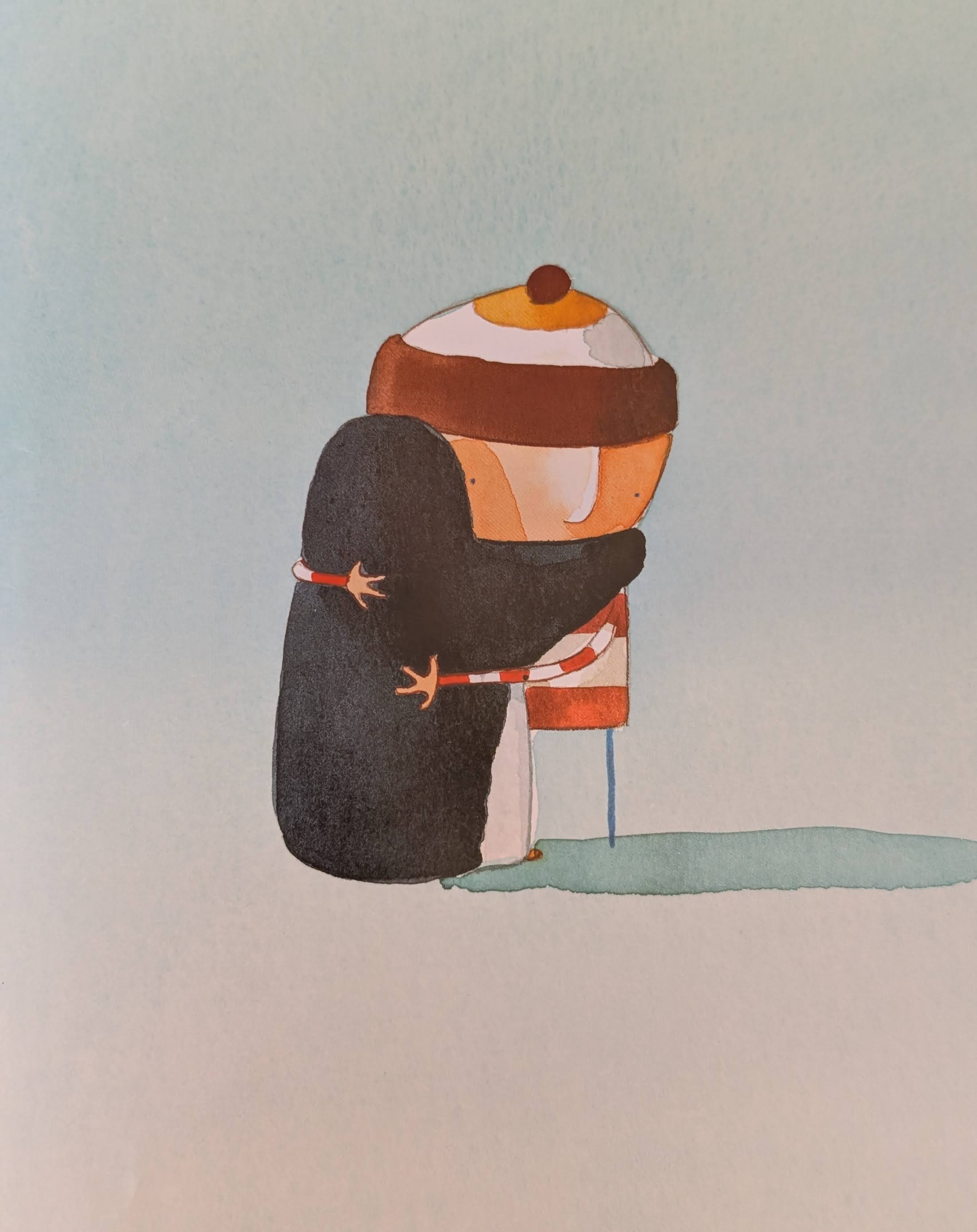
In the book, the penguin shows up at the boy’s home. The boy shoos it away, then when the penguin persists, he tries to help it find where it’s supposed to be. He finds out through some careful research that penguins live at the south pole, and absent any realistic way to get there, they take a rowboat together. Of course, it is the journey that makes them. The boy drops off the penguin then realizes he’s made a terrible mistake. The above picture is when they are reunited. I’m a little weepy now, and that was a very rushed synopsis of the story.
Grant: He’s trying to find his real home, and he says he’s not lost, he is alone. The boy was sailing and he’s like, I need to go back and find the penguin. And he does, but the penguin isn’t here. And thinks the penguin is sailing, and goes and finds him, and they hug.
The Way Back Home
The Way Back Home is both charming and jolly.

It once again features the boy (but alas, only a cameo from the penguin), who discovers he has an aeroplane. Another seamless blending of make believe and reality. Again there is a gentle subversion of expectation, in that both the boy and the martian are afraid of each other, but then become great friends. I also very much appreciate the part where the boy gets distracted halfway through his mission. I know a boy very much like that. This one always gets Grant wondering if they keep in touch. I love that.
Grant: The alien and the boy crash. And then they’re saving each other. The boy goes back down, and he takes a break for a long time. And he’s like, oh wait, I need to go back up. He gets the tools, and he climbs a mountain, and he shouted, and a rope came down.
Where to Hide a Star
And luckily, this next book implicitly answers the question of whether the boy and martian keep in touch! Where to Hide a Star brings back the boy, the penguin, the star, and the martian, while introducing a new friend. I love it because it brings back all the characters I’ve already fallen in love with, and shows that there is always space for more friendship. I’m charmed by the solution to the problem of sharing that crops up, and how well the friends support one another.
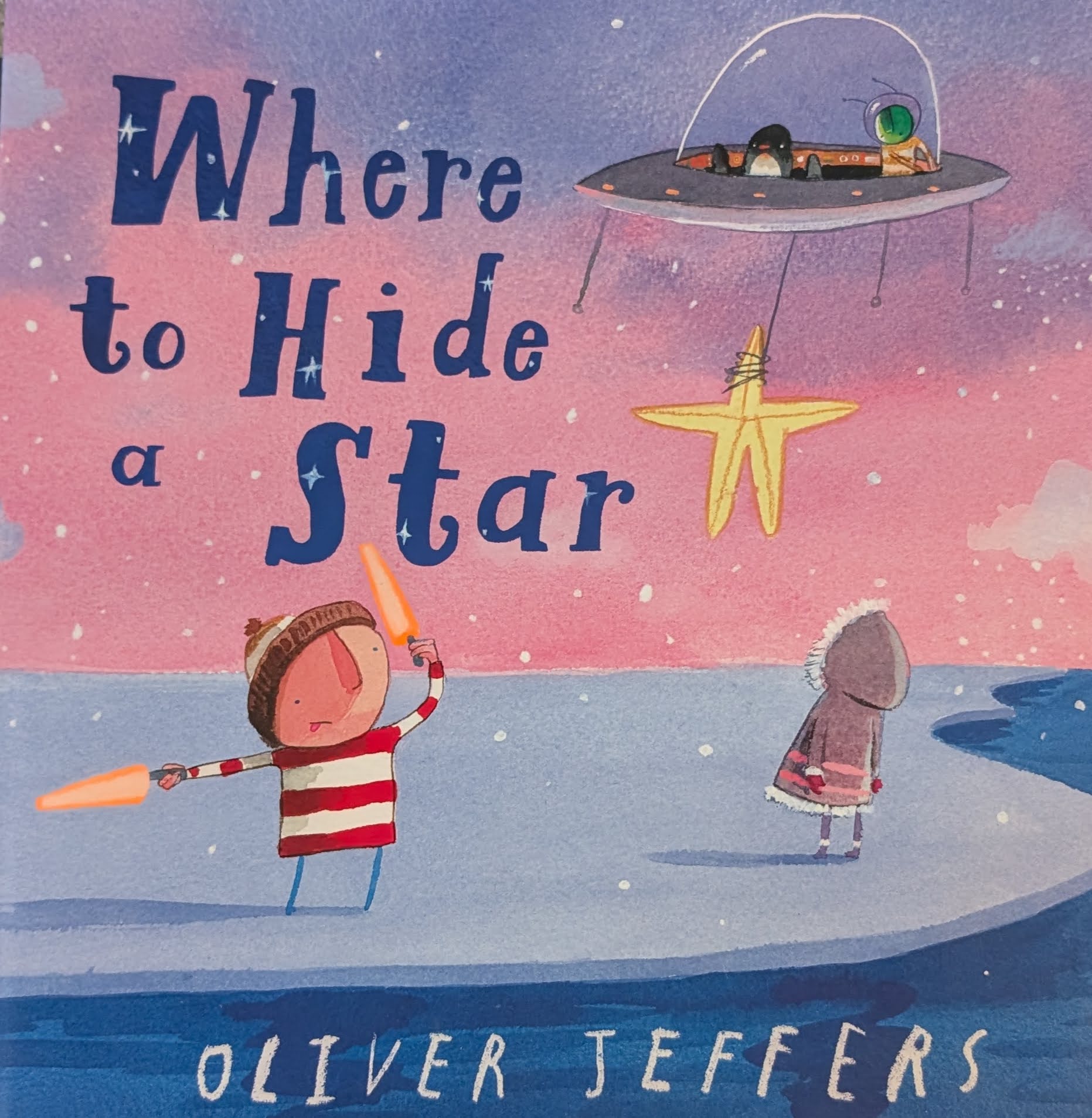
Grant: One day the penguin and the star were playing hide and seek. And the penguin, when he was hiding in a very good spot, got stuck. And the boy put the star in his boat, and he helped the penguin, and then he didn’t see the star, and he thought the star was just hiding again, and he looked in all the good hiding places, but he wasn’t there. And he was like, where could he be hiding, he’s good at hiding. And then he sees his sailboat is not there, and then he’s like oh no. And from The Way Back Home, he got a walkie talkie from the martian, and the martian came and he got them a ride in his spaceship. When he finds the star, he sees that he has a new friend. And they play another game of hide and seek, and the martian and the penguin will help hide the star. And they look everywhere, and then the girl had a walkie talkie now, and they both saw the star at night.
Other Collaborations
I guess next we’ll do the rest of the collaborations – we already did The Day the Crayons Quit, and now that I’m thinking of it, I’m pretty sure we have one called The Day the Crayons Came Home, though I don’t know where it is either. The other two we have from the Crayons series are The Crayons Go Back to School and The Day the Crayons Made Friends.
The Crayons go Back to School
In Back to School, the crayons pick up at the end of Quit. Each crayon finds joy in charming and unique ways throughout the book, as they return to their old haunts with new perspectives. It helps to have read Quit first, in that it lays the groundwork for some additional layers, but it’s not necessary. A sweet and funny read.

Grant: Some of them make friends, and they all are on their summer break. And they are going back to school, and Peach is finally going to wear clothes!
The Day the Crayons Made Friends
In The Day the Crayons Made Friends, the crayons pull another Quit, in that they abandon their crayon box and head for the hills. Except this time, they make friends at home, around the house. And of course, they send letters back to the boy who colors with them (Duncan). Both Quit and Friends are about finding what’s right for you, and not being afraid of pursuing it.
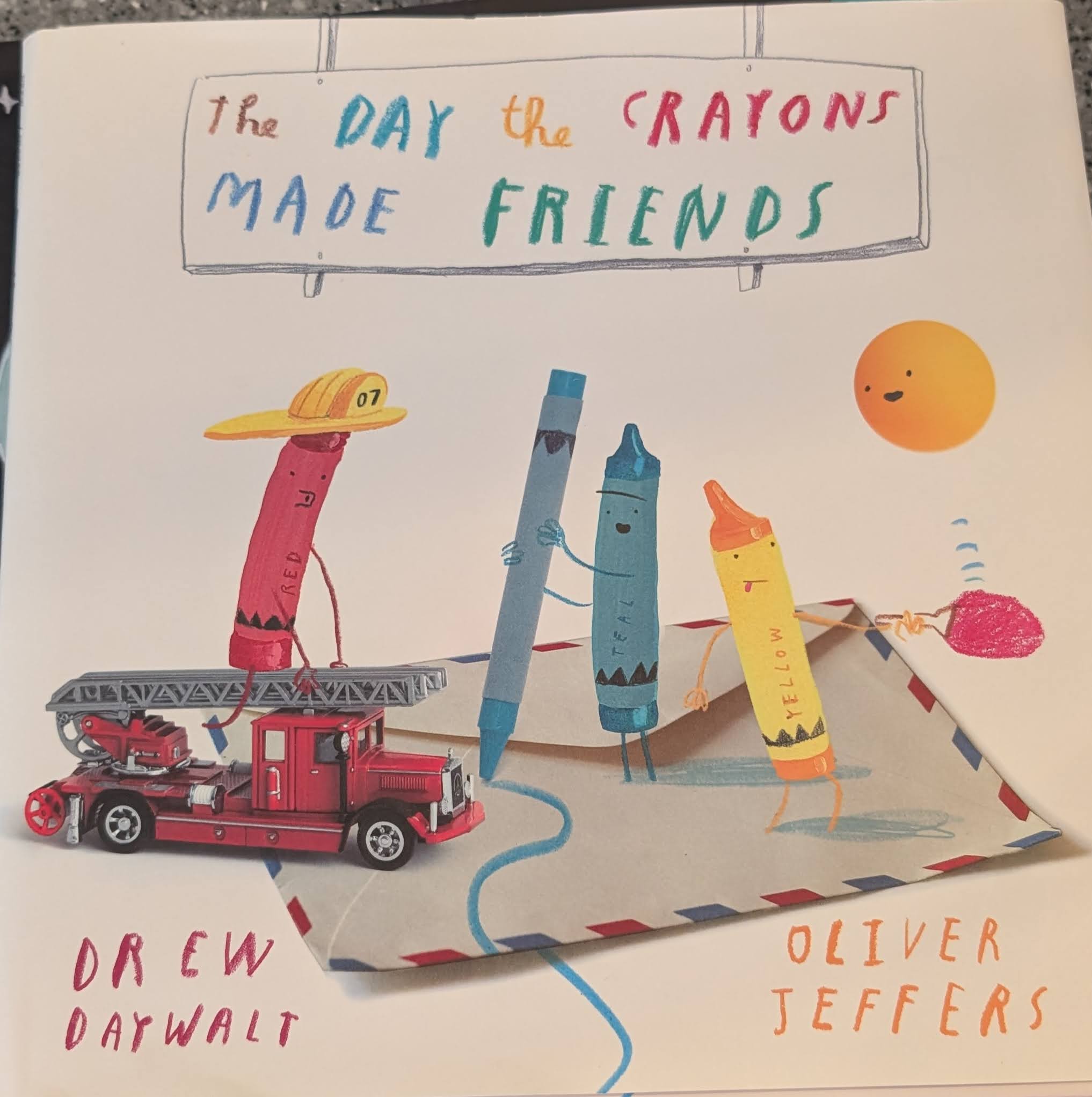

Who isn’t delighted by Baron Von Nuddington? Also this book came with a little 8×8 print of Yellow Crayon, that we framed and hung up in Grant’s room. It’s next to the Oliver Jeffers poster I bought him from the Brooklyn Museum.
Grant: Yellow is like, what’s going on ping pong? And the ping pong ball says hi. And there’s two paddles. And Yellow crayon hits the net, and ping pong goes over the net.
The Dictionary Story
So next we have the Sam Winston collaborations. The Dictionary Story is really fun, because it plays with type and the idea of type as illustration rather than strictly something you would read (this seems to be Sam Winston’s specialty).

One of the things we really like doing every time we read this book is look at every single spine of every single book and read them out loud and laugh about them or talk about what they mean.

The first time Grant looked at the French version and saw the books were in French, he had to take a moment and think it through. We looked at both versions together (quite similar to how the books are actually arranged in the above picture) and tried to puzzle out if all the books were the same or if there were some new titles snuck into the French verison. I think they’re all the same.
Something Grant has pointed out to me before is that Oliver Jeffers has a very distinct cloud with rain/lightning and tornado.

We spend a lot of time looking through his tornados to see what we can spot. Can you spot a familiar face? What I like so much about these is that we can take time to talk through why he might have included any particular element. What does it tell us? What does it make us think further about? Also Grant loves when I do a silly voice for the queen in this story.
Grant: Alligator and donut make lots of bad stuff happen. And he gets a bite and the donut is afraid. And when the donut gets scared he says “oh sprinkles!” and he says “more sprinkles” another time, and he says “all the sprinkles” when the tornado gets mad. But then something is happening – it’s called the ABCs, and they were all in their places again, and the dictionary was not A dictionary, it was The Dictionary Story.

A Child of Books
Next is A Child of Books, the final collaboration (that we own, anyway), also with Sam Winston. I love this story (read and your imagination will flourish), but I especially love the art in this one.

I think this is my favorite spread:

I read all the branches to Grant, and we talk about why those stories might have been chosen. When he first noticed the trunks were books, he was so tickled. That’s why I love this page so much.
Also, here’s another really delightful tornado:

Not all tornados are destructive! This one builds new worlds, like the big bang.
Grant: All of the little stories inside of it are cool. And the girl, they sneak out of the house with the boy, and they do lots of fun adventures. Also, lots of fairy tales.
Letters, books, and words
This is a category of one.
Once Upon an Alphabet
Thematically, I like Once Upon an Alphabet next. It’s little stories for each letter. We particularly like The Lumberjack’s Light (for the letter L).
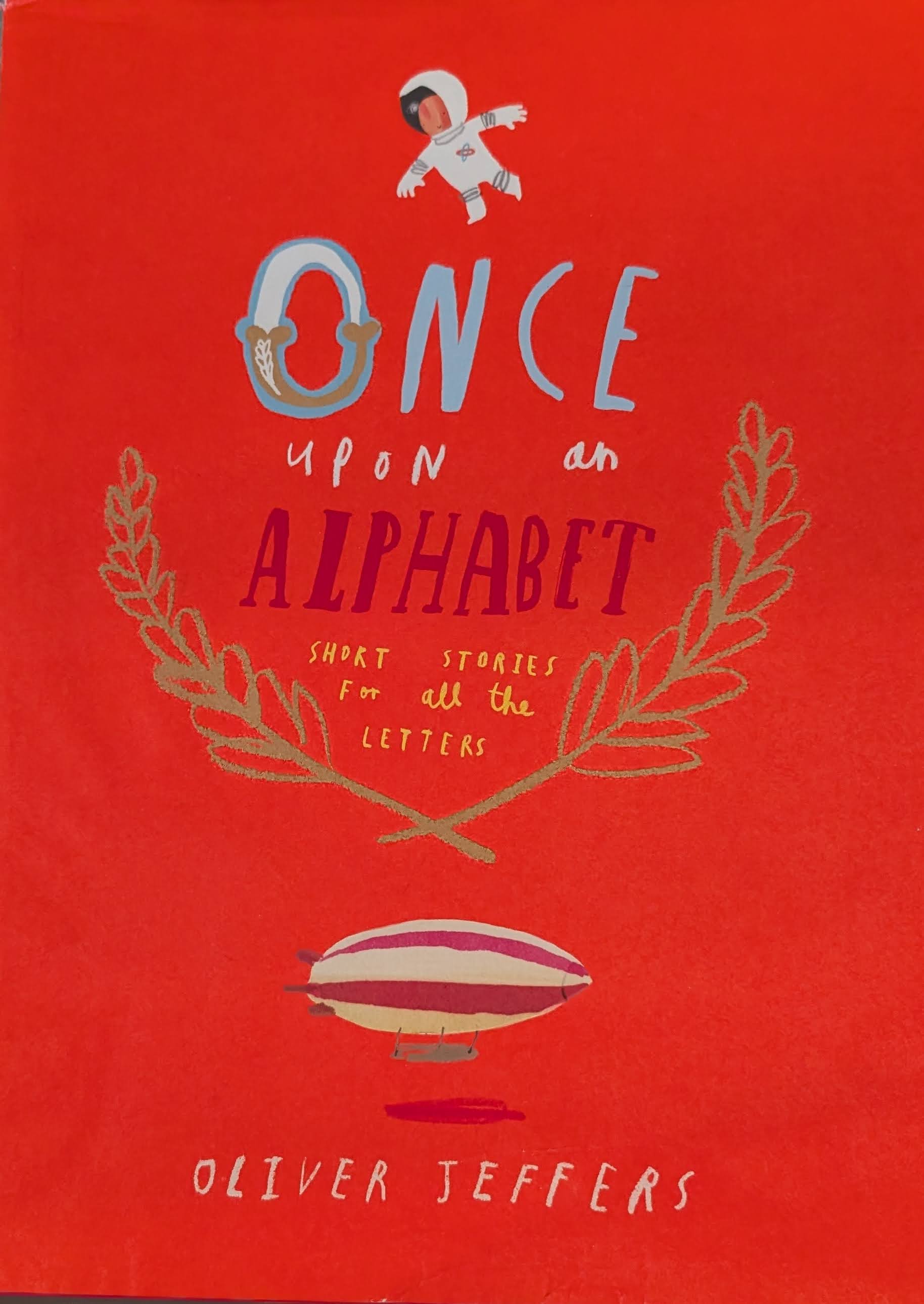
In particular, we like this illustration from L, and I think it’s probably pretty clear why. Or maybe not! Anyway, it charms us.

We also like the story for the letter O, which I won’t spoil. I like that these are all standalone little stories, but they weave through each other, too. If you pay a little bit of attention (and Grant pays a lot of bit of attention). He loves spotting how an element in one story will show up in another. It gives us a lot to look at and talk about.
Grant: It is really big! It has the alphabet on the end paper and I like that all of the stuff that Oliver Jeffers did is really impressive, because he needed to do all these 26 things and they were really good.
Existential Stories
Ok, next I think three more fit thematically, so we’ll tackle them at the same time, in the order I purchased them in. Here We Are, What We’ll Build, and Meanwhile Back on Earth.
Here We Are
Here We Are also kind of makes me a little weepy?

It’s advice for his son (though, for anyone really) about what matters and what we don’t need to worry about. It has a driving simplicity that is contrasted with rich illustrations that make each page thought-provoking, without that much text.

I’m indexing a little bit on the tornado style drawings, but Grant and I really do look at these particular illustrations for a long time. It opens up the opportunity to talk about when is the first time a baby sees a mountain? What might they think about that? What is something Grant probably saw a lot of that this baby might not see any of until he’s older? Just lots of good stuff for introspection, and thinking about how our society works.
Grant: I like that it talks about the earth a lot. And tells you a lot of good stuff. It shows you about lots and lots of stuff. It tells you the landscapes. He made this book because he’s really smart, because they need to be smart. It shows the atmosphere, and here we are (the earth) and the moon, and all the other stuff, like the sun, venus, jupiter, saturn, mars, pluto, mercury. He says “our solar system is one of not millions, not billions, but trillions.”
What We’ll Build
What We’ll Build is a quasi poem, it feels like. It’s fairly lyrical. Another blend between make believe and real, and directed at his daughter and the relationship they can build together. What I appreciate here is that he truly wants to bring his daughter along to do things together, and not just typical little girl things, but a whole life of things.
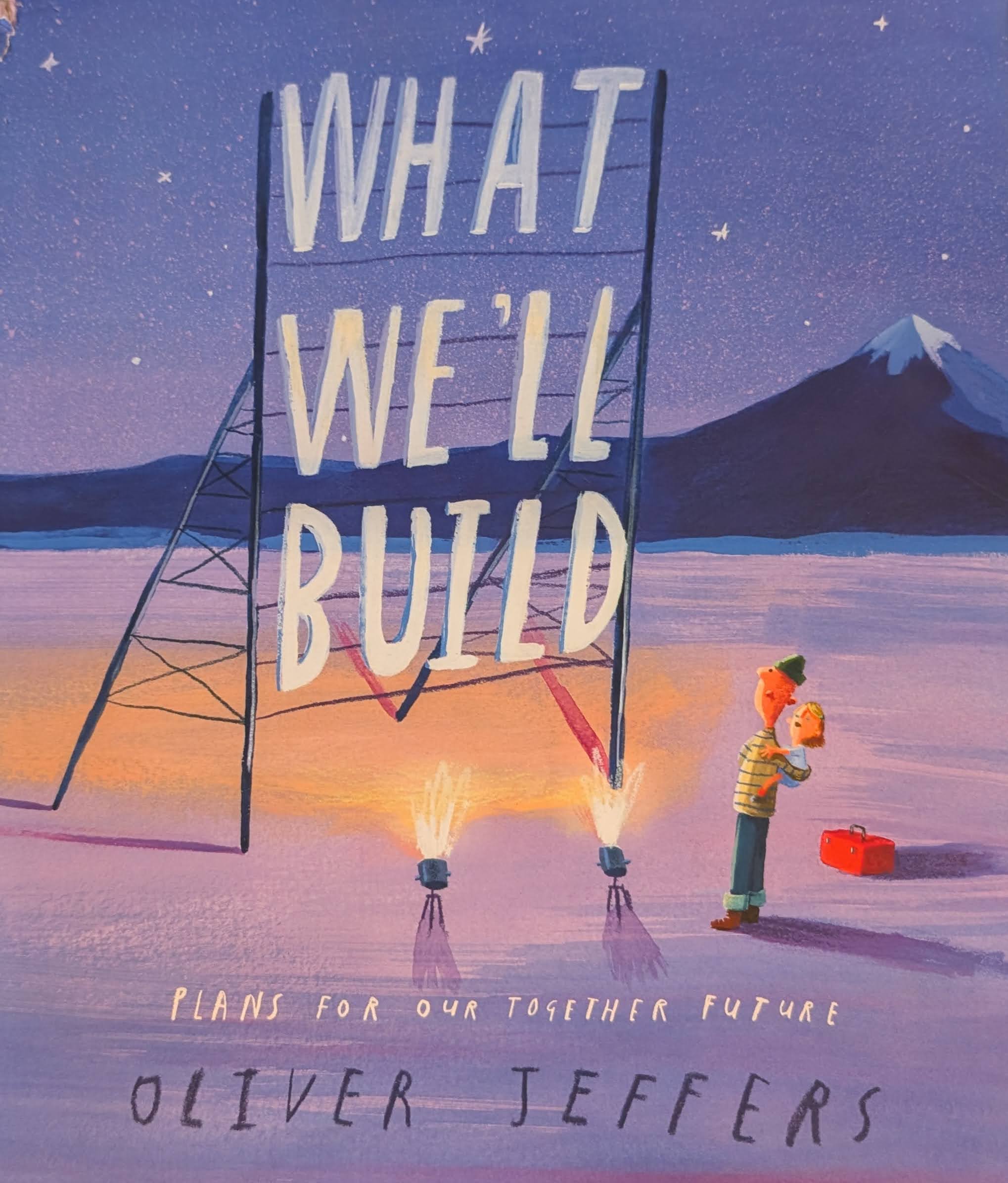
Grant: I like that it’s imaginary. And that they built a house to protect the girl and the father himself. They dig a hole where they can hide. Then mean people, so they made a castle and a big wall. And they were being rude, but you don’t always lose, so we’ll build a gate and let them in. Then they say “I’m sorry” and “me too” and “me three” and probably me four and me five after that. And they built a road to the moon, and the moon has a face! Just like in The Dictionary Story, and you also see the witch who was being rude. And then we see an astronaut, and they go to the moon and relax with their space helmets, and there’s two birds that have space helmets, and there’s two trees that don’t have space helmets.

Grant chose this picture to include from What We’ll Build, because he likes that there’s chaos, and the penguin.
Meanwhile Back on Earth
Meanwhile Back on Earth is lovely for gaining perspective. Why fight each other, little petty fights, and massive conflicts, when we are so, so, so insignificant (in a good way). I related to the dad in this story (we always call the adult man in these books “Oliver Jeffers” and I don’t know if that’s his intent, but there we are), because he’s got kids bickering in the backseat, and just trying to talk them through it. I mean, in real life if I’m driving I go berserk in a deeply unattractive way, but if I’m not driving, I do try to reason.
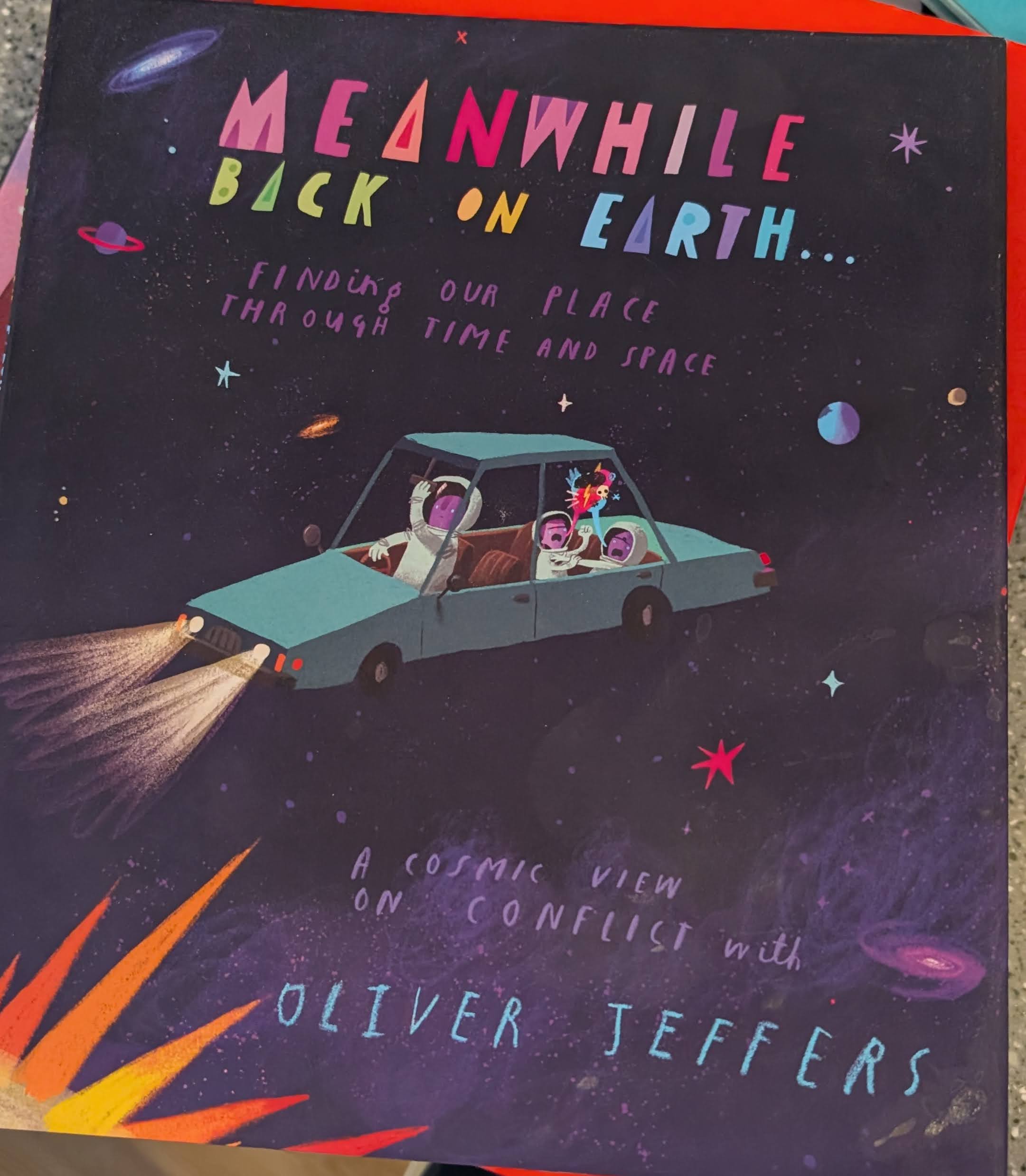
Grant: I only like when they’re being rude, but also Oliver Jeffers did a lot of math in this one, like he always does, because he’s smart. And of course all his books are fiction, and now a car is flying in outer space very close to the sun, and that’s why I love it so much. Also Pluto is 3,581M miles away. Also the sun is 92M miles away from the earth.
These are our Newest Reads
These next three go together just because they’re our newest ones, and so therefore they are a family.
I’m Very Busy
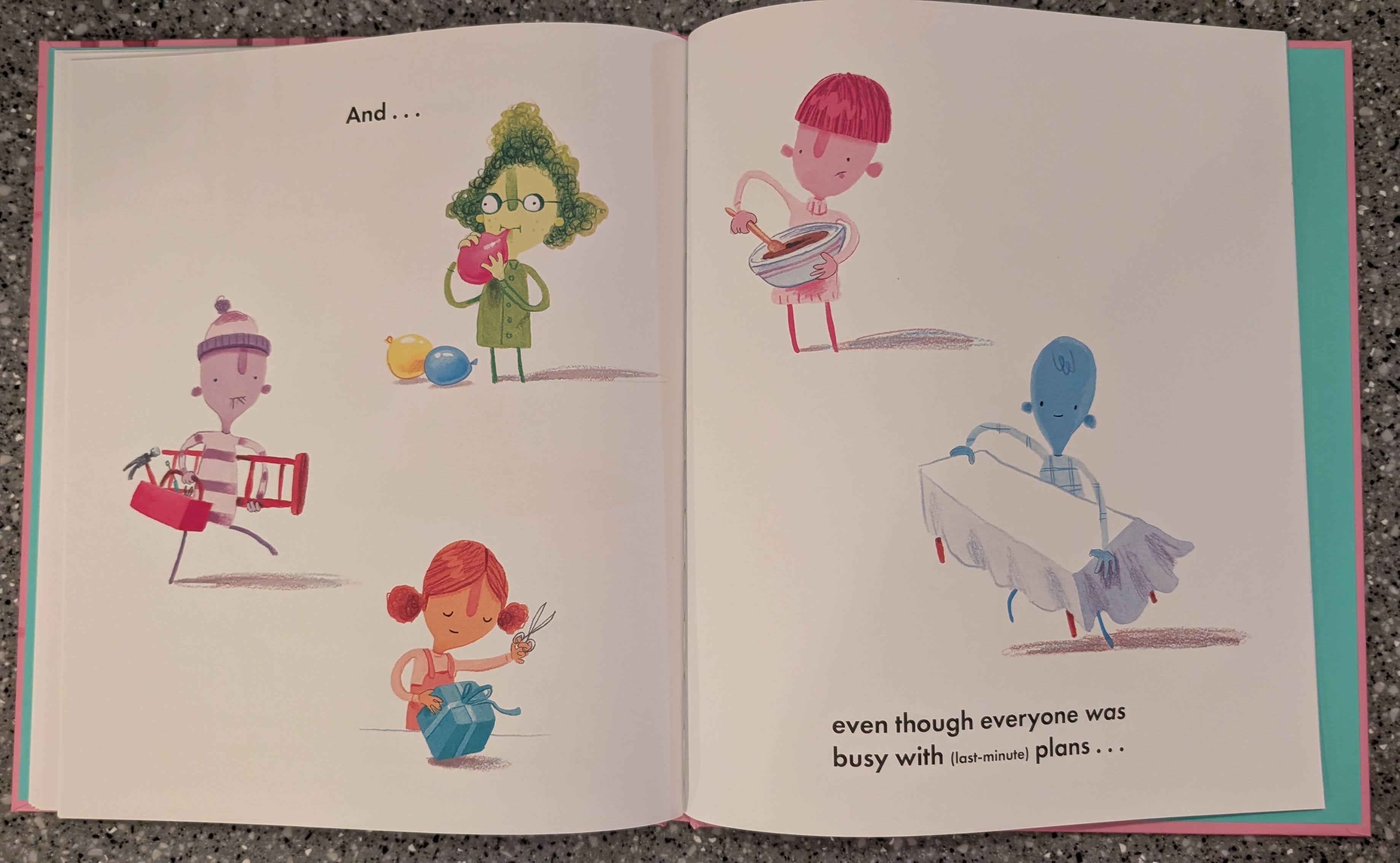
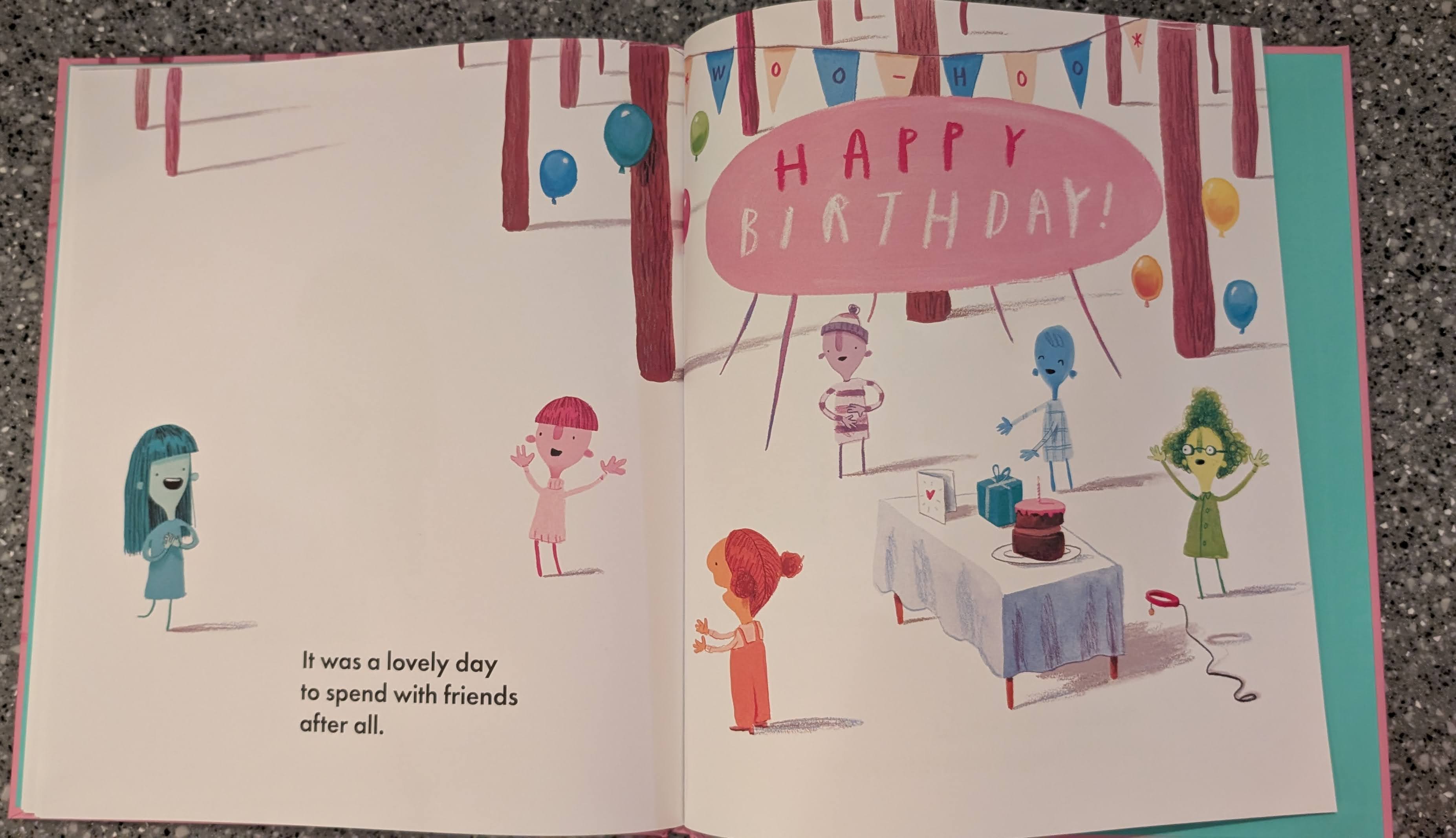
I’m Very Busy is a cute read. And it looks like Grant and I had different takeaways from it. My read was that the friends made time for their friend when they realized they forgot, and Grant’s is that the friends were busy with party plans from the start. He’s an optimist! From here on out there are more interior pictures because Grant got involved.

Grant: Everyone is really busy in this book, and they forgot about her birthday. And she tries to get their attention, and then they’re like, wait, it’s Bridget’s birthday, but they were all making stuff for her. That’s why they were so busy. And this guy has dog that isn’t a dog, but is an invisible dog, and he’s just walking this dog and minding his own business. “I’m too busy” he says.

There’s a Ghost in this House
There’s a Ghost in this House is very cleverly done. Using painted translucent overlays, you can see how the house appears to the little girl, and how it appears to the ghosts who live there. It’s really quite delightful. Also, Oliver Jeffers has assigned ghosts the collective noun “fraid” so there’s a fraid of ghosts in this house. Super cute.
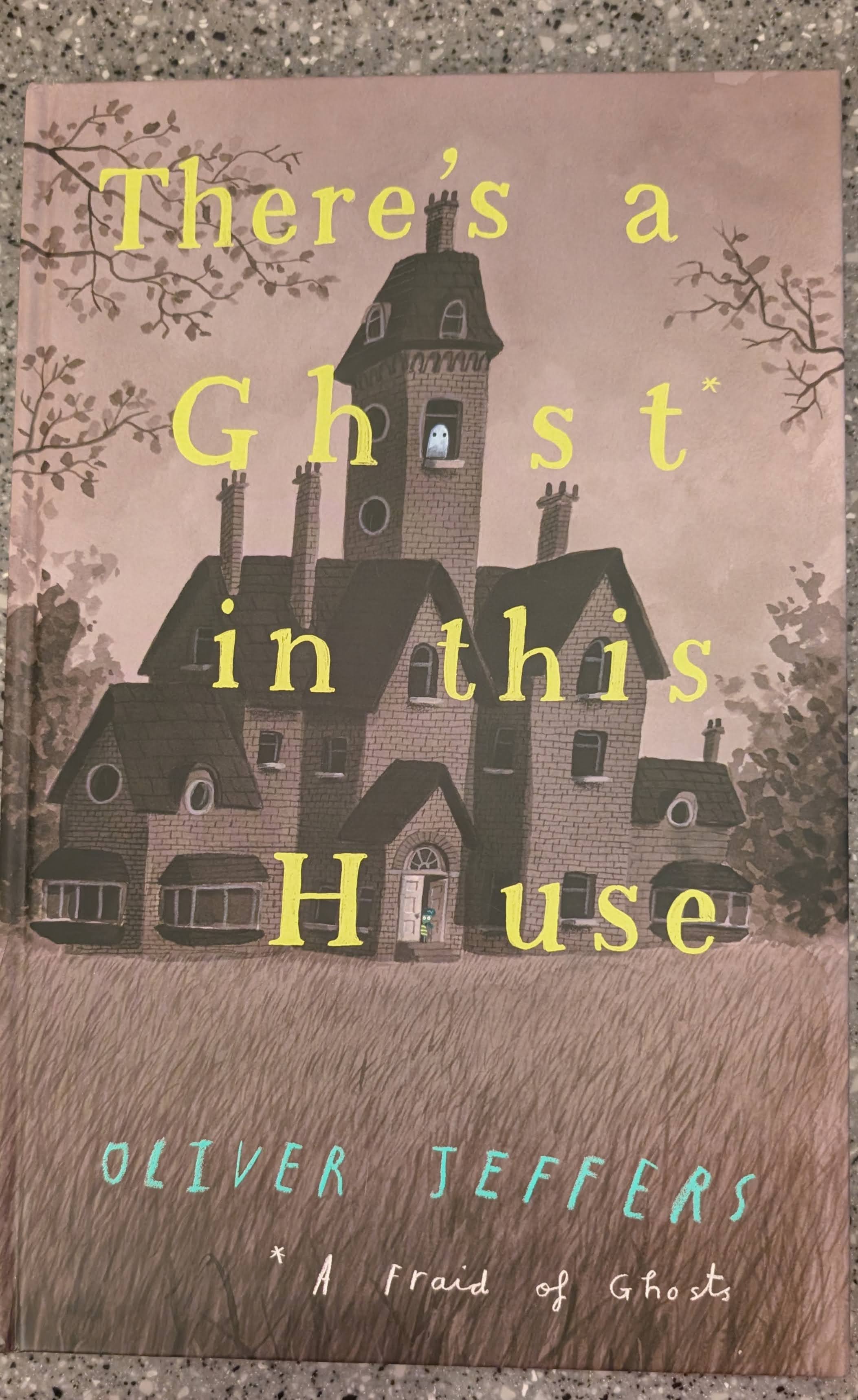
Grant: The O in “ghost” and “house” on the front cover is a window and a door! What I like about this book is that she thinks there are ghosts in her house, and you flip a page and you see them a little bit. There’s different designs. It looks like it’s painted. And we were the first ones to ever open this book. She looks everywhere and everywhere and everywhere and everywhere and everywhere. But she could not find them. And that one is dressed up to look like he has a chain on him. And now he’s laughing. And now they’re in the bathroom – one’s toilet paper. Now they’re drinking coffee. Now one’s on the shelf, and one’s just looking at a book. And now they’re just spying on her, basically. And one’s also a clock. And one’s the fearless painting. And they are all in the attic. There’s another baby one, and they’re all jumping on the bed. And now they’re sitting in front of the bed. And then, when one is drinking coffee, he’s holding it magically basically, and she actually finds them.

The Fate of Fausto
The Fate of Fausto is a fable. I think that’s why Grant thinks it’s true. What I like about reading this one is that I feel that the message is that we can’t own anything, really. We can only hope to understand it, and then come to love it. I went through a period a few years ago where I just wanted to read fables, which led me to read the utterly divine Night Circus. Digression. This one is a true pleasure to hold. It is shorter and narrower than the other books, and the cover has the feel of some of the books I have from the 1950s. Hopefully nobody gnaws on this one, but gnawing is pretty typical round these parts.

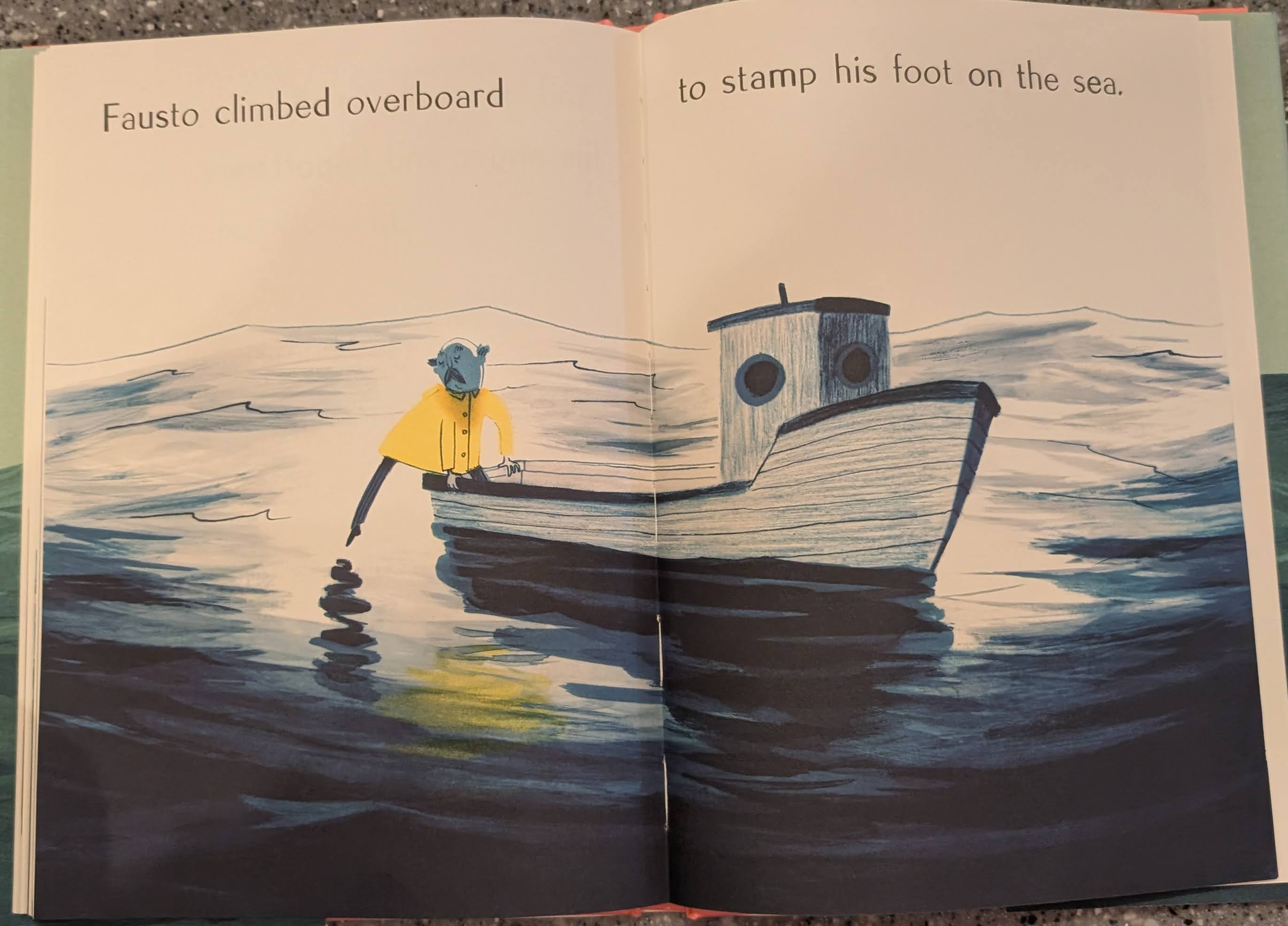
Grant: This is a true story, and this guy owns everything. This flower, Fausto takes the flower and a sheep. Yes said the sheep. And now there’s an F on the sheep. Tree, you are mine now. Then the tree bows. Then he says “Lake you are mine”. And then nothing came from the lake, but Fausto showed the lake who was boss. And then he says “mountain you are mine.” The mountain says no, I am my own. Fausto stomps his foot. Fausto was so bad that the mountain said “yes, you are in charge.” He sets sail. He has too much stuff. Then he says, “sea, you are mine” but the sea was silent. Then the sea says “you do not own me.” Fausto said “You are wrong.” Just him sailing the sea. Fausto was lying and did not love the sea and the sea knew it. “I’ll show you who’s boss! I will stamp my foot!” And Fausto climbed overboard to stamp his foot on the sea, but he did not understand. Plop, in he goes to the sea.
Those are all our Oliver Jeffers books! I’m glad Grant was willing to sit with me and go through each one (oh what a hardship, he loved it) and figure out how to tell me what he liked without telling me the story (to varying degrees of success, as you will notice, though the same could be said of me).
I recently read a review of Oliver Jeffers’ dip performances, because it was included in the footnotes of his latest newsletter, and I’m glad I did. He’s an artist with something to say, and I am really enjoying discovering these other little bits of what he does, besides the books we have here. From the beginning (for us, which was Lost and Found), I was utterly entranced by the art in the book. I could stare at it for hours. Partly because I thought, “how do I do that?” There’s a certain economy of line and color that brings his illustrations to life. On his website, he speaks about this very thing, that you don’t see the thousands of attempts that aren’t just so. And that’s ok! I enjoy the glimpses of the process, and then getting to bask in all the art of his we already have in our house, thanks to these books. All the ideas we can plumb them for. The gift of perspective.
 Revelry Reverie
Leave a comment